Turning RHTP Insight into Action: What Mobile Healthcare Providers Need to Know Now
The Rural Health Transformation Program (RHTP) is no longer theoretical. States are planning, identifying partners, and implementation will follow quickly.
All 50 states have received initial awards from CMS, each tasked with deploying roughly $1 billion to improve healthcare access and outcomes. But as state plans take shape, one message is becoming clear:
This is not a planning grant. This is an outcomes-driven initiative, and the timeline is tight.
To better understand how RHTP is unfolding and what it means for mobile providers, explore our dedicated resource hub:
👉 https://mobilehca.org/rhtp/
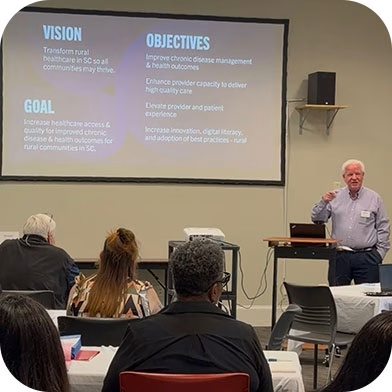
At a recent Southeast coalition meeting, Dr. Ron Gimbel, Professor and Director of Clemson Rural Health, shared key insights into how states, particularly South Carolina, are approaching RHTP implementation. His perspective reinforces both the urgency and the opportunity for mobile healthcare providers.
From Funding to Outcomes: A Different Kind of Program
Unlike many federal initiatives, RHTP funding comes with time-sensitive expectations:
– Funds are not released until CMS approves state plans
– Projects must demonstrate measurable outcomes quickly
– In South Carolina, initial funding year is limited to a one-year cycle
– States face strong pressure to show transformational results or risk future funding
Most organizations that succeed under RHTP will be those already delivering care and have initiatives ready to scale, less so those organizations starting from scratch.
For mobile healthcare providers, this creates both a challenge and an advantage. Programs that are already operational can position themselves as ready to expand solutions aligned with CMS RHTP priorities.
Where Mobile Healthcare Fits in RHTP
For a deeper breakdown of how these priorities are showing up across states, visit our RHTP hub:
👉 https://mobilehca.org/rhtp/
State plans, like South Carolina’s, are organizing funding across several priority areas. Within these, mobile healthcare is not just relevant, it is essential.
- Telehealth and Digital Infrastructure
States are investing heavily in telehealth expansion, remote patient monitoring, and digital tools. The vision is clear: bring care into the home and closer to the patient.
For mobile providers, this opens the door to hybrid models that combine mobile units with virtual care and remote monitoring.
- Leveling Up Existing Programs
This category focuses on scaling what already works—expanding proven models, growing pilot programs, and increasing patient reach.
Best fit for mobile providers: organizations with established programs and measurable outcomes, especially in chronic disease management.
- Wellness Within Reach
This is where mobile healthcare is most directly aligned.
Focused on removing access barriers in rural communities, this category includes:
– Mobile units
– Pop-up care sites
– Behavioral health expansion
States are prioritizing care delivery that meets patients where they are, making mobile models a natural fit.
- Financial Sustainability and Workforce Development
This area includes facility enhancements, workforce expansion, and innovative care delivery models.
There is growing interest in:
– Extending specialty care into rural areas
– Leveraging mobile units for higher acuity services
– Using team-based care and technology to expand capacity
The Real Constraints Providers Must Navigate
While the opportunity is substantial, so are the operational realities.
– Short timelines may mean funding must be spent within 12 months
– Procurement pressure means contracting and mobile unit build times may not align with funding cycles
– Workforce shortages remain especially acute in rural and specialty care
– Reimbursement gaps continue to challenge services such as remote patient monitoring until payers align with the innovation
What This Means for Mobile Healthcare Providers
RHTP is not just about innovation. It is about execution at speed.
To compete effectively, organizations should:
– Demonstrate that programs are operational today
– Show measurable outcomes (improvement), especially in chronic disease
– Position services for rapid scale
– Align with state priorities around improving care access and outcomes
– Build collaborative partnerships with health systems, FQHCs, state agencies, and others you know and have a positive history with
For tools and guidance on positioning your program, visit:
👉 https://mobilehca.org/rhtp/
The strongest proposals will not necessarily be the most novel. They will be the most deployable and aligned with RHTP goals.
Don’t Overlook Your State’s RHTP Plan
While national guidance is important, RHTP is implemented at the state level, and each state’s approach will differ.
Many state health departments are already publishing detailed information on:
– Funding priorities
– Application processes
– Timelines and key dates
– Eligible project types
For example, the Maine Department of Health and Human Services has created a dedicated RHTP page outlining its strategy and opportunities:
👉 https://www.maine.gov/dhhs/ruralhealth
Action step: Check your state health department website and search for RHTP or Rural Health Transformation Program to find the most relevant guidance for your region.
We’re also compiling state-level updates and links in one place here:
👉 https://mobilehca.org/rhtp/
As states finalize and approve plans, timelines will move quickly, making it critical to stay informed at both the national and state level.
Building on the Momentum: Turning Insight into Action
Earlier this year, Mobile Healthcare Association explored how the Rural Health Transformation Program (RHTP) could fuel the next era of mobile care. What we are now seeing from state leaders confirms that direction and increases the urgency for action.
Across the field, a consistent message is emerging. RHTP will only succeed if it reaches people where they are, and mobile healthcare is one of the most direct ways to do that.
Research from Mobile Health Map underscores this point, noting that mobile clinics play a critical role in addressing persistent rural barriers such as transportation gaps, provider shortages, and delayed diagnosis. Their data shows mobile programs routinely extend care into communities that traditional systems struggle to reach, especially for chronic disease management and preventive services.
Similarly, Driving Health Forward highlights that this moment represents a structural shift in rural health strategy. Their analysis emphasizes that mobile care is no longer a supplemental service. It is increasingly being viewed as core infrastructure for equitable access, particularly as states design outcome-driven funding models like RHTP.
These perspectives align closely with what we are hearing from state leaders. Funding will favor models that are already operational, scalable, and able to demonstrate measurable outcomes quickly.
As mentioned above, our RHTP resource hub continues to evolve as states finalize plans:
👉 https://mobilehca.org/rhtp/
Staying Connected: Coalitions, Special Interest Groups, and Upcoming Convenings
RHTP is not a static funding announcement. It is an ongoing, state-driven implementation process that will continue to evolve over the coming months. Staying connected to peers and partners will be essential as priorities, timelines, and funding mechanisms take shape.
Across the country, our Regional Coalitions and Special Interest Groups are playing an important role in helping organizations share lessons learned, identify partnership opportunities, and align strategies for RHTP funding. These forums provide a space for providers, health systems, and community organizations to compare approaches and respond more quickly to emerging state guidance.
In addition, upcoming convenings, including the 22nd Annual Mobile Health Clinics Conference, will serve as a key opportunity for organizations working in mobile and rural health to engage directly with peers who are actively building RHTP-aligned programs. These gatherings are becoming an important mechanism for translating policy into practice and ensuring that innovative models are visible as states finalize their funding strategies.
For organizations engaged in mobile healthcare, participation in these networks is increasingly less optional and more strategic. The pace of implementation means that relationships, shared learning, and coordinated approaches will directly influence how effectively programs can position themselves for funding opportunities.
The Bottom Line
RHTP is accelerating a broader shift already underway in rural health—moving care closer to patients rather than the other way around.
The evidence from across the field is increasingly clear. Mobile healthcare is not peripheral to that transformation. It is central to it.
In a rapidly moving funding environment, connection is not just helpful. It is a competitive advantage.